
My Body Health sells at-home “body sensitivity” tests that promise to analyse how you react to a very wide range of foods and environmental factors.
I completed their 1,750-item Body Sensitivity Test from Sydney.
This review focuses on what it is actually like to use the test in Australia, how professional and trustworthy the experience feels, what the results look like in real life, and how much confidence you should place in those results.
Important disclaimer: I’m not a medical professional. This review is based on personal experience and independent research, and is therefore not medical advice, diagnosis, or treatment. Always consult a GP or qualified health professional before making changes to your diet, supplements, or medications.
Check My Body Health Review
Check My Body Health - Review Summary
A slick, well-run service with fast results and a thorough report, but the bioresonance method isn’t backed by mainstream medicine. Best for curious, non-urgent folks who want a structured push into an elimination diet; not for anyone seeking clinical answers or dealing with serious symptoms.
Overall
-
Ordering - Website - 8/10
8/10
-
Products - Quality & Experience - 6/10
6/10
-
Ordering - Delivery - 6/10
6/10
-
Value For Money - 8/10
8/10
Pros
- Smooth, professional process after posting, with clear, timely email updates.
- Fast turnaround once received (two business days) and results match what’s promised.
- Detailed report and guide that make running a proper elimination diet easy.
- Reasonable price (often discounted), so it feels like a low-risk experiment.
- Meal Planner adapts recipes to your exclusions and helps keep meals varied.
Cons
- DIY hair sample and pay-your-own postage feels odd and a bit unpolished.
- Bioresonance isn’t accepted by mainstream medicine, so results aren’t clinically reliable.
- The long list of “reactives” can be overwhelming and unrealistic to cut all at once.
- Auto-enrolment into The Meal Planners is sneaky, and the tool can be clunky with odd portion suggestions.
- Not suitable if you need definitive answers or have serious symptoms. See a GP instead.
Page Contents
What is Check My Body Health and what are they selling?
Check My Body Health sits firmly in the direct-to-consumer wellness testing space. You buy your test online, send a sample in by post, and receive a digital report that lists your “sensitivities”.
The headline product I tried is the Body Sensitivity Test. It tests reactivity to 1,750 items across 47 categories. That spans common foods and drinks, additives, botanicals, some environmental materials (like fabrics), and newer “wellness” markers such as stress, sleep and skin health.
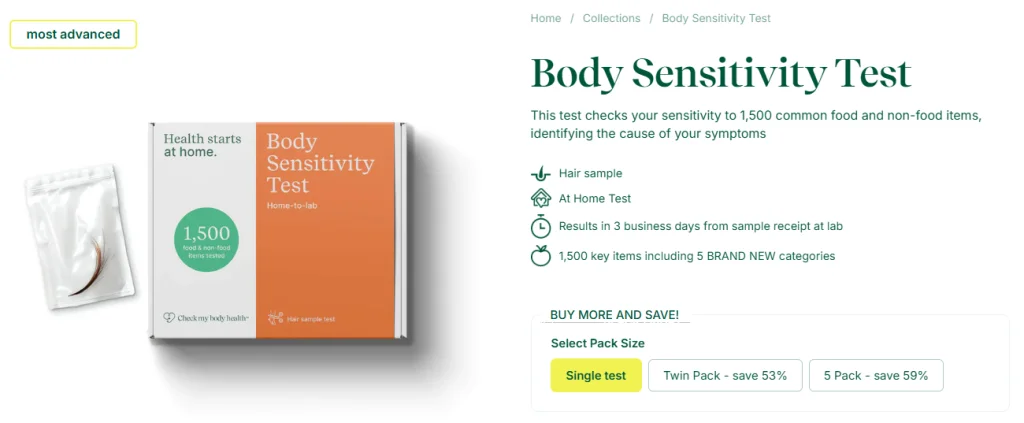
The company says it has processed more than 500,000 tests across 25+ countries. They position the service as a convenient way to explore potential triggers if you have ongoing symptoms like bloating, fatigue or skin issues.
In Australia, you order online via a localised site, pay in AUD, and send a small hair sample to their lab. They offer three hair-sample sensitivity panels:
- Essentials (650 items) – the lowest-cost panel covering common foods and non-foods.
- Complete (990 items) – 990 items; a broader panel if you want more coverage.
- Body Sensitivity Test (around 1,500 items) – the full panel including additional ‘wellness’ markers.
The process in Australia: odd at first, but smooth and professional
The end-to-end process is simple, but also a bit unusual.
After purchasing the Body Sensitivity Test online, you receive a reference code and instructions. There is no physical kit posted to you. Instead, you are asked to:
- Activate your test online with your reference code.
- Cut a small sample of hair from your head or body.
- Place the hair in a small plastic bag with your details.
- Post it to their lab address, paying your own postage.
There is something slightly strange about cutting your hair, placing it in a zip-lock bag, and sending it through the regular mail with a stamp. It feels more “DIY” than the usual medical-style test kits that include lancets, tubes or swabs.


You also have to remember that you are paying for postage yourself; there is no prepaid envelope.
Once the sample is in the post, the experience becomes much more polished. My Body Health has a decent workflow behind the scenes, and this is where they feel more seamless and trustworthy.
After I sent my hair, I received a series of status update emails that let me know:
- When they had received my sample.
- When the sample had moved into processing.
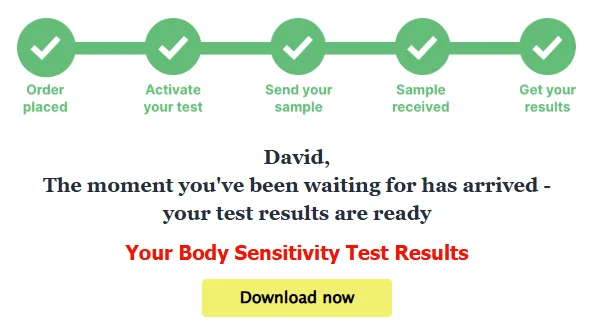
- When my report was ready to download.
The tone of these emails is friendly and informative, and they arrive at sensible intervals so you never feel like your sample has just vanished. Combined with the branding, the layout of the emails, and the eventual report, the whole experience feels more professional and joined-up than the “plastic bag and stamp” step might suggest.
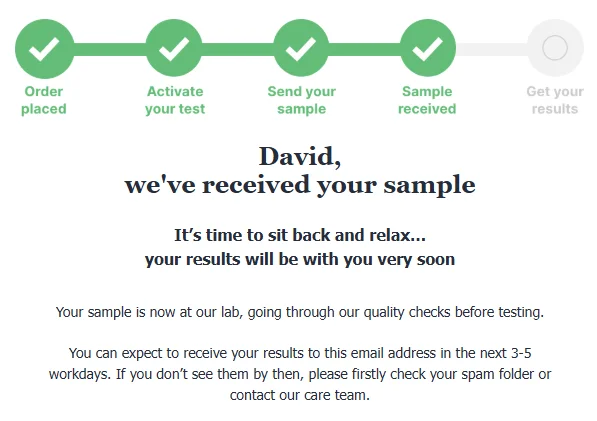
Turnaround from the point the lab acknowledged receipt was quick. Results arrived two business days later, which fits their promise of delivering results within about three to five working days after receipt.
For context, I posted my sample on 23 October and the lab acknowledgement email came through on Monday 3 November. I can’t confirm the exact day the lab physically received the envelope, but this timeline suggests the postal leg is the main variable, while the lab processing itself is fast once your sample is logged.
That meant it took me just under 2 weeks to get my results from the day I posted the sample.
What the results looked like: 1,750 items and a lot to digest
The results are delivered as a multi-page PDF report that looks more like a laboratory result than a marketing brochure. It is detailed, consistent, and clearly laid out.
At the very front, the report restates your name, unique reference code, and test summary. In my case it confirmed:
- 1,750 items tested across 47 categories.
- 190 items in the High Reactivity / Outside Range category.
- 71 items in the Moderate Reactivity category.
- 1,489 items in the No Reactivity / Within Range category.
The report explains how the three reactivity levels should be interpreted.
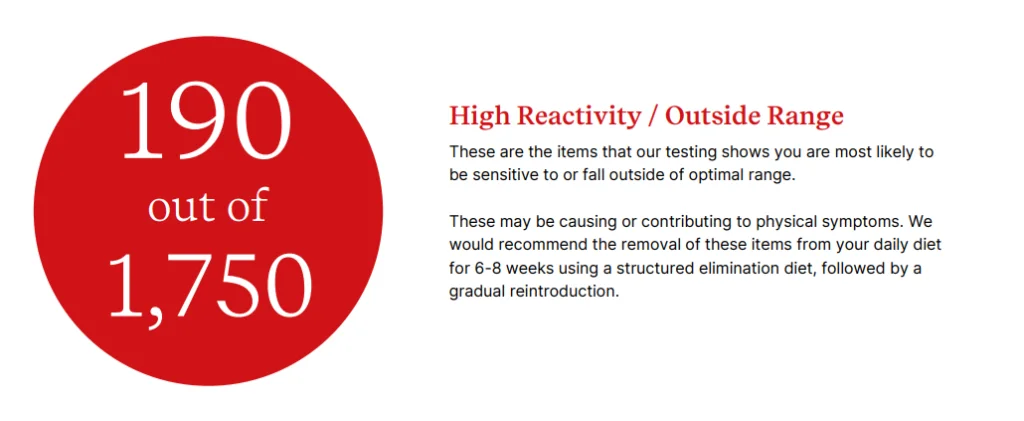
High reactivity items are those the system suggests you are most likely to be sensitive to or where your readings fall outside an “optimal range”. The guidance is to remove these foods for six to eight weeks and then reintroduce them carefully.
Moderate items are recommended for four to six weeks of removal, ideally once you have dealt with the high group.
No reactivity items are positioned as safe to eat, unless you already know you have an allergy or intolerance.
Concrete examples from my report
The most useful way to understand the test is to look at what actually appeared in my own results.
On the high reactivity food list, I saw a large cluster of:
- Dairy products such as milk, cream, cheese varieties (cheddar, gouda, brie, mozzarella, parmesan, Roquefort, cottage cheese and more), plus yogurt and ice cream.
- Coconut products such as coconut milk, coconut kefir, coconut water and coconut oil.
- Rice and rice-based items like white rice, brown rice, germinated rice, rice drink, rice noodles and rice wine.
- Nuts and seeds including peanut, hazelnut and pine nuts.
- Alcoholic beverages such as beer, lager, rum, sake and vermouth.
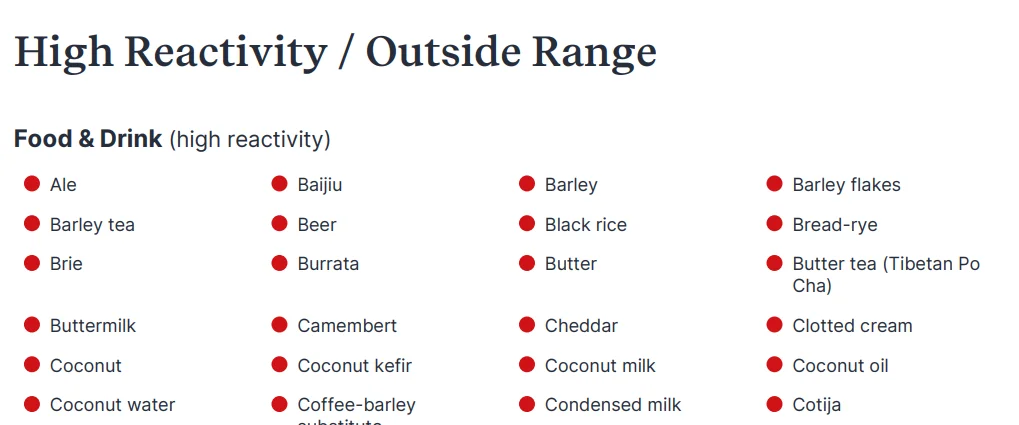
Beyond food, the test also flags non-food sensitivities. My high reactivity section included fabrics and animal-related items such as acrylic fabric, cashmere, denim, fleece, neoprene, feathers from different birds, mouse dander and polyester. These appear in the report as potential environmental triggers, not dietary ones.

The Body Sensitivity Test also includes newer “wellness” categories. For me, the following were listed as out of range or high reactivity:
- Gut health markers such as Lactobacillus strains, E. coli and other bacteria.
- Stress and inflammation via cortisol.
- Sleep via melatonin.
- Skin health via sensitivity to certain cosmetic and preservative ingredients.
- Nutrition via markers like anthocyanidins and carotenoids.

This gives the report a much broader feel than a simple “what foods do I avoid” list. Whether or not these markers are scientifically meaningful is a separate question, but the information is presented clearly (albeit overwhelmingly).
The supporting material
Alongside the lists, My Body Health provides a Results Guide booklet that explains:
- How bioresonance hair testing is claimed to work.
- The difference between sensitivity and allergy.
- The structure and purpose of an elimination diet.
- A reintroduction diary template so you can track symptoms as you bring foods back.
The guide emphasises that:
- This is not an allergy test.
- Hair testing does not measure antibodies and cannot be used to diagnose allergy.
- Bioresonance is a form of complementary and alternative medicine rather than mainstream medicine.
Between the report and the guide, you end up with a very structured set of next steps. In practical terms, the real value is the prompt to run a proper elimination diet using your results as a shortlist rather than guessing.
The flip side is that the sheer number of high and moderate items, particularly when they include big staples like dairy, rice and nuts, can feel overwhelming. It is not realistic for most people to cut all of them at once, so you have to use some judgement and pick a manageable starting point.
Can My Body Health be trusted and does bioresonance work?
This is the core question for most readers. There are really two separate issues:
- Whether the service experience and company operations are trustworthy.
- Whether the bioresonance method itself is scientifically reliable for food sensitivity testing.
Service trustworthiness
On the service side, My Body Health presents as a legitimate, well-run consumer business:
- The company is a UK-based entity that trades internationally and operates region-specific sites including an Australian portal.
- They claim to have processed more than half a million tests globally and cite an internal customer satisfaction rate above 90 percent.
- Reviews collated in the research show many positive comments about ease of use, speed of results, and the clarity of the reports, although opinions on accuracy are more mixed.
- In my own case, communication was prompt, the email updates arrived at sensible points in the process, and the report itself looked professionally produced and consistent with what the marketing promised.
On that basis, I would say the service delivery is trustworthy. You get what you paid for, and the process is organised, responsive and transparent enough that you never feel scammed.
The much harder question is whether the test results themselves can be trusted as an accurate representation of what your body is reacting to.
What My Body Health says about bioresonance
My Body Health explains its method as bioresonance hair testing based on concepts from quantum physics. The idea is that everything, including your body and the foods you eat, emits measurable frequencies. By comparing the frequencies in your hair sample to reference frequencies for different foods and substances, the machine claims to infer reactivity.
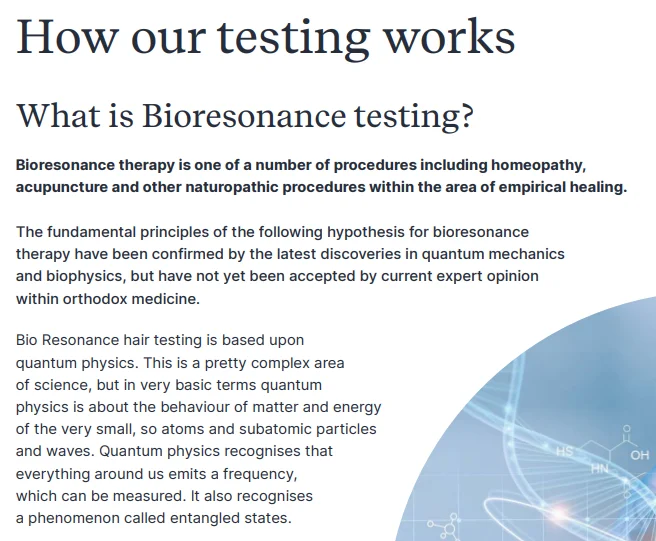
Crucially, the company’s own documentation makes two key admissions:
- Bioresonance therapy is categorised as complementary and alternative medicine (CAM).
- The “fundamental principles” behind bioresonance have not yet been accepted by current expert opinion within orthodox medicine.
The results guide also emphasises that the test:
- Does not measure antibodies.
- Cannot be used to diagnose allergies.
- Is intended as a starting point for lifestyle changes rather than a medical diagnosis.
In other words, My Body Health is explicit that this is not a clinical test in the same sense as a blood-based allergy or intolerance panel in a hospital or pathology lab.
What mainstream medical and independent sources say
The independent research that underpinned this review looked at medical position statements, investigative journalism and third-party reviews. The picture that emerges is fairly consistent:
- Professional allergy and immunology organisations, such as the Australasian Society of Clinical Immunology and Allergy (ASCIA), advise against the use of hair analysis, Vegatest, electrodermal testing and other bioresonance-style methods for diagnosing food allergy or intolerance. They note that these methods lack scientific validity, show poor reproducibility and can lead to inappropriate dietary restriction.
- Clinical reviews and guideline documents cited in the research categorise hair analysis and bioresonance as unproven or discredited for allergy diagnosis and stress that they should not replace evidence-based tests such as skin prick tests, IgE blood tests, oral food challenges or medically supervised elimination diets.
- A consumer investigation by The Guardian into online food sensitivity tests raised concerns about the reliability of bioresonance-based services, including variability in results and a lack of robust scientific backing, even where customers reported subjective benefit from following the suggested diet.
- Independent review sites such as Nebula Genomics and SelfDecode concluded that while CheckMyBodyHealth can be a useful motivator for dietary experimentation, bioresonance hair testing itself is not supported by strong evidence, and doctors often do not regard the results as clinically meaningful.
In short, mainstream medicine does not consider bioresonance testing a reliable or validated way to diagnose food intolerance or sensitivity.
How I interpret the test as a consumer
Putting all of this together, my own view is:
- The service is well run and professional from a customer standpoint.
- The science behind the hair analysis is weak and not accepted by conventional medicine.
- The useful part of the experience is the structured elimination diet, not the precise list of “high reactivity” items itself.
If you treat the results as an interesting input into a broader self-experiment, they can be helpful. They can nudge you to finally eliminate dairy or gluten or certain additives for a few weeks, track your symptoms, and then make your own call on what genuinely helps.
If you treat the results as a definitive medical verdict on what your body can and cannot tolerate, you are likely to be disappointed. Anyone with severe symptoms, weight loss, nutrient deficiencies, or suspected allergy should see a GP or specialist and use validated tests instead.
Value for money
One reason people are drawn to My Body Health is that the cost is relatively modest compared to private specialist testing or repeated consultations, particularly in a system where wait lists can be long.
The service is often promoted with heavy discounts and bundle deals, which positions it as a low-risk experiment rather than a major investment. Here are the standard prices, although you should always check the offer we’re sharing as well:
| Test | Standard Price |
|---|---|
| Body Sensitivity Test | $62.95 |
| Complete Food Sensitivity Test | $46.95 |
| Essentials Food Sensitivity Test | $26.95 |
From my perspective, the value comes from:
- The quality and depth of the report.
- The structure it gives to an elimination diet.
- The speed and smoothness of the process.
If you go in knowing that the science is not rock-solid, the price feels reasonable for what you get.
The Meal Planners add‑on
One thing that isn’t 100% obvious at checkout: when you buy a sensitivity test you’re automatically enrolled in a service called ‘The Meal Planners’ at$4.99/month. It’s bundled with the test, it needs to be actively removed if you don’t want to subscribe, and you need to cancel it yourself if you don’t want ongoing charges. I found this a little sneaky and easy to miss.
What you actually get is a recipe library and planner that adapts to your results and preferences. In testing, I liked how it handled exclusions and still surfaced varied meals, and the shopping lists make weekly planning simpler. If you’re cutting out big staples like dairy or rice, it’s a handy way to keep meals interesting without starting from scratch.
There are quirks. To hit calorie targets, the planner sometimes scales portions to odd extremes, mine suggested a breakfast of five eggs plus 36 spears of asparagus which would be… a lot. Therefore I’d treat the serving sizes as a starting point. Use the ideas, then adjust portions to suit what you’ll actually eat.

I also found the interface was very basic and slightly confusing at times trying to navigate.
That being said, if you want recipe inspiration within your diet, The Meal Planners is a useful tool. Just set a reminder to review the recurring $4.99 and cancel if you don’t plan to keep using it.
Who Check My Body Health might suit
Check My Body Health’s Body Sensitivity Test is likely to suit you if:
- You are curious and open to complementary or alternative approaches.
- You have bothersome but non-urgent symptoms such as bloating, mild gut issues or fatigue, and you want a structured way to start experimenting with your diet.
- You like data and long lists and are comfortable sifting through a detailed report to find a sensible, realistic elimination plan.
- You understand that this is not a substitute for proper allergy testing or medical advice.
In that context, the test can be a useful motivational tool to try a serious elimination diet instead of constantly guessing.
Who Check My Body Health is not right for
On the other hand, I would be cautious about recommending this test if:
- You have symptoms that could indicate a serious medical condition, such as unexplained weight loss, blood in the stool, severe pain, or a history of anaphylaxis.
- You are hoping for a single authoritative answer that completely explains your health issues.
- You are prone to restrictive eating or anxiety around food and might interpret a long “reactive” list as a strict ban on large parts of your diet.
In these situations, it is much safer and more constructive to start with your GP or an accredited dietitian and work through validated testing and supervised elimination diets.
Final verdict
My Body Health delivers a smooth and professional customer experience in Australia. The ordering process is easy, the email updates feel reassuring, and the final report is thorough and thoughtfully presented. The test is relatively affordable and, in my view, the elimination diet it encourages can genuinely help some people understand their symptoms better.
However, the core method, bioresonance hair testing, is not accepted by mainstream medicine and lacks strong scientific support. The company is open about the fact that this is complementary medicine, and independent medical organisations advise against relying on such tests for diagnosis.
If you treat My Body Health’s Body Sensitivity Test as a low-risk wellness experiment and a prompt to run a structured elimination diet, it can be worthwhile. If you are looking for clinically reliable answers, or you have serious or worrying symptoms, you will need to look elsewhere and speak with a medical professional. If you’re also curious about personalised vitamins alongside an elimination diet, you might find my Vitable review helpful.
