
Xinzuo Knives Review (2026): Three Knives Tested on Meal Kit Prep
Nearly every HelloFresh and Dinnerly recipe I’ve cooked starts with the same jobs: dice an onion, slice a capsicum, crush some garlic. The box may contain the raw ingredients, but the knife is down to you. In my experience, a blunt one turns ten minutes of prep into a chore.
So when Xinzuo Australia got in touch offering knives to test, it felt like a natural fit for Food Box Mate. I say no to most of the brands that email me, but I liked the look of their website, and a good knife is the one piece of kit every meal kit cook needs.
I wanted to know whether spending more makes a real difference to everyday meal kit cooking, so I picked two chef’s knives at very different prices: the $65.95 Supreme and the $145.95 Mo. To round out the order I added a nakiri for vegetables and a set of steak knives. I skipped the specialist knives, because meal kit cooking is fairly basic.
After a couple of weeks of meal kit prep, the short version is that the more expensive Mo is the better knife, but the cheap Supreme has the nicer handle and is a great upgrade from your typical supermarket knives. The steak knives are still waiting for a steak night, so I’ll add my thoughts on those later.
Xinzuo sent me a store voucher to choose the knives. They haven’t seen this review prior to publishing or had any input into it.
 David’s verdict: Xinzuo Knives Review
Xinzuo Australia is a Brisbane-based distributor selling a huge range of Chinese-made kitchen knives, from reasonably priced German-steel chef’s knives up to premium powder-steel blades. The website is easy to shop, with clear steel and hardness details for every knife, and orders ship quickly from Brisbane with free delivery over $100.
Overall
8.3/10
Overall 8.3 out of 10
- 9Ordering - Website
- 8Products - Quality & Experience
- 9Ordering - Delivery
- 7Value For Money
Pros
- Ships from Brisbane, with same-day dispatch before noon and free shipping over $100
- Easy-to-shop website that explains each knife’s steel and hardness
- Wide range, from $65.95 everyday knives to premium powder-steel blades
- Every knife arrives gift boxed with a blade guard, and engraving starts at $19
- Afterpay available at checkout
Cons
- Returns only cover unused knives, which you pay the return postage for
- The “lifetime” warranty excludes chips, rust, dulling and dishwasher damage
- No sharpening service
- Some knives arrive under the Hezhen brand without the website saying so
- Star ratings on product pages are pooled across whole series
Who are Xinzuo?
You may have seen the Xinzuo name on Amazon, where it sells worldwide. The knives are made in Yangjiang, a city in China’s Guangdong province with a long history of knife-making, by Yangjiang Xinzuo Industry and Trade Co., which was founded in 2014.
Here in Australia, the knives are sold by Xinzuo Australia, an independent distributor that has been trading since early 2025. It ships from a warehouse in Wacol, Brisbane, so you’re buying from a local business covered by Australian Consumer Law.
Watch out for separate websites that also sells Xinzuo knives (at large ‘advertised’ discounts). The warranty only covers knives bought from xinzuo.com.au or an authorised retailer, so check who you’re buying from before chasing a cheaper price.
What do Xinzuo sell?
The Australian store lists more than 260 products across about 17 series, which is a lot to wade through. I’m a home cook, not a knife collector, but once you look closely, most of the price difference comes down to the steel:
| Steel | Hardness (HRC) | Example series | 8″ chef’s knife price |
|---|---|---|---|
| German stainless (1.4116) | 56–58 | Supreme | $65.95 |
| Chinese 10Cr15CoMoV, layered or Damascus | 60 ± 2 | Pin, Zhen, Yu, Mo | $109.95–$145.95 |
| Powder steel (14Cr14MoVNb, M390, ZDP-189) | 60–67 | Lan, X1, Li | $169.95–$429.95 |
Prices checked on xinzuo.com.au on 25 October 2026.
Damascus is the wavy pattern you see on the side of the blade. Xinzuo’s is genuine forge-welded steel, made from layers of softer stainless wrapped around a harder core. The core does all the cutting, so the pattern is mostly there to look fancy.
The hardness number tells you how the edge will behave when cutting and maintaining the knife. German knives around 56 to 58 HRC are easy to sharpen and forgive a bit of rough treatment, but they need sharpening more often. Xinzuo’s 60-ish knives should stay sharp for longer, though they can chip if they hit a bone or a block of frozen mince.
Delivery, returns and the “lifetime” warranty
Regular shipping is free on orders over $100 ($14.95 otherwise). Orders placed before noon Brisbane time on a business day go out the same day. I ordered on a Sunday and mine went out with Australia Post on the Tuesday, after the Queensland public holiday.
You can pay with Afterpay. Engraving costs $19 a knife for one line or $29 for two, which is a nice touch if you’re buying one as a present.
The fine print is worth reading before you buy:
- Returns: 30 days, but only for unused knives in their original packaging, and you pay the return postage unless the knife is faulty. You can’t cook with one for a week and send it back.
- Warranty: Xinzuo calls it a limited lifetime warranty. It covers manufacturing faults such as cracks, loose rivets and a splitting handle, for household use only.
- What the warranty excludes: chips from bones, frozen food or hard seeds; rust from the dishwasher or poor care; normal dulling; and any commercial use.
- Sharpening: there’s no sharpening service, so budget for a whetstone or a local knife sharpener.
Returns matter more with knives than with most things, because you only find out whether a handle suits your hand once you’ve physically held it.
My Xinzuo review knives
My order arrived with Australia Post in a padded black satchel, with each knife boxed separately inside.
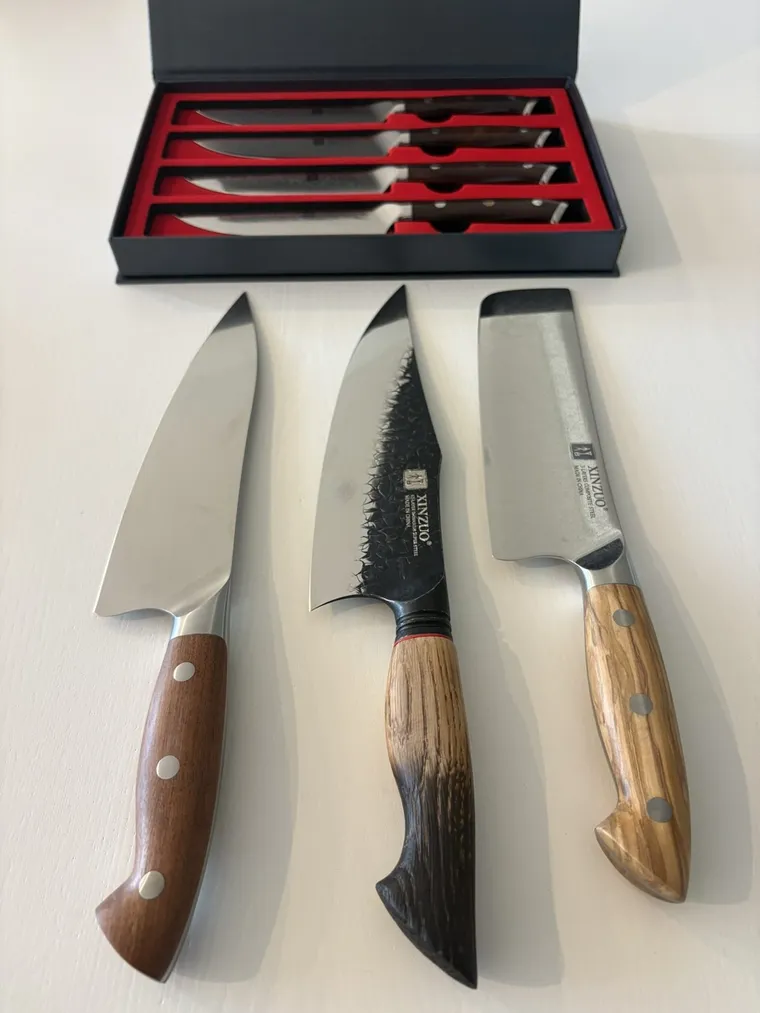
Three came in black Xinzuo gift boxes. Each knife sat in foam under a plastic sleeve, with a blade guard, a care leaflet and a product booklet. All of the knives also held a small quality certificate from the factory in Yangjiang, stamped “PASS” by an inspector.
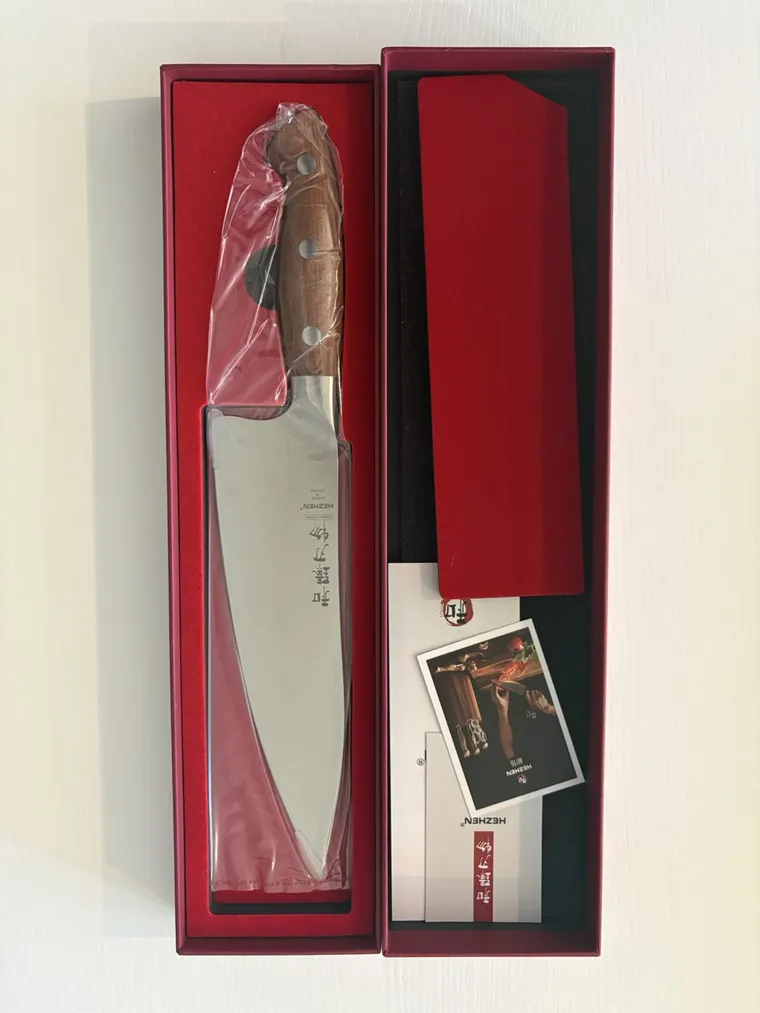
The fourth box was the odd one out. My $65.95 Supreme chef’s knife turned up in a white box branded Hezhen, with a red interior and Hezhen etched on the blade. Hezhen is a second label made in the same factory, but the Supreme’s product page on xinzuo.com.au never mentions it, so expect a different brand name to arrive if you order one.
Packaging for the steak knives was the fanciest of the lot, with four knives lined up in a red-lined magnetic box that’s ready to wrap as a gift.
Cooking with the Xinzuo knives
Mo Series 8.5″ chef’s knife ($145.95)
As the most expensive knife in the box, the Mo had the most to prove, and it was extremely sharp straight out of the box. It’s beautifully balanced, with the weight sitting towards the blade. I like that, because the knife does more of the work on each cut and I do less.
The blade is shaped for rocking back and forth across the board, which suits the way I chop. Its colouring is beautiful too, with a black hammered finish along the spine and a burnt oak handle.
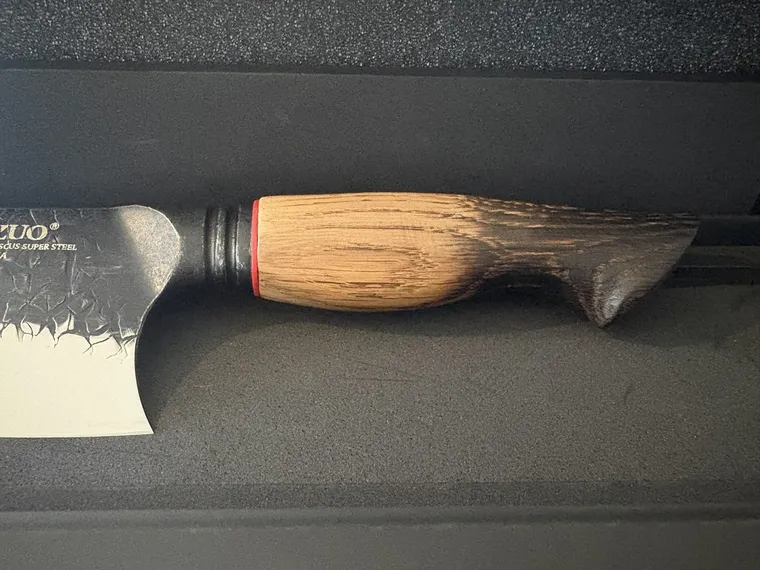
There are two things to watch. The heel, the back corner of the blade nearest the handle, comes to a sharp point that’s easy to catch yourself on which I’m surprised they didn’t round off. Secondly, if you’ve got big hands, the handle may also feel a little small.
The Mo has a partial tang, meaning a narrow spike of steel runs into the handle rather than a full-width strip. That’s common on Japanese-style knives and fine for slicing and chopping, but I wouldn’t use it to lever through a pumpkin or hack at bones.
Supreme Series 8″ chef’s knife, sold in a Hezhen box ($65.95)
Picking up the Supreme straight after the Mo, it feels light. That surprised me when I checked the specs, because Xinzuo lists it three grams heavier. The difference is where the weight sits, further back towards the handle, so you have to push harder to get through each cut.
I put both chef’s knives through the same tomatoes, and the Supreme couldn’t slice them as thinly as the Mo.
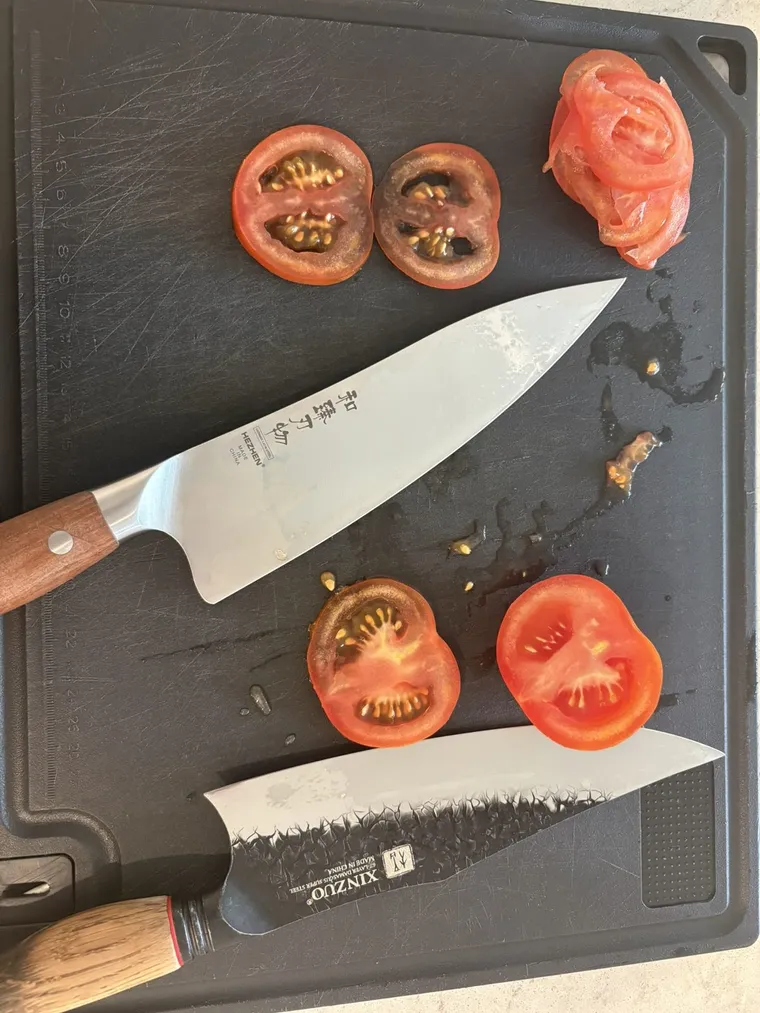
It still does the job with a rocking or pressing motion, and it has the most comfortable handle of the three. That handle sits naturally in the hand, which counts for a lot when there’s a pile of veg to get through.
The blade is 1.4116 stainless, the same family of steel most German knife brands use. It’s softer than the Mo’s steel, so expect to hone or sharpen it more often.
Pin Series 7″ nakiri ($105.95)
I’ve been calling this one the cleaver, and it’s easy to see why. A nakiri is a Japanese vegetable knife with a tall, straight blade, and mine looks like a small cleaver.
Give it something tough to cut and it’s in its element. The blade is very sharp, and the straight push cut a nakiri is built for goes easily through hard vegetables.
Although it’s lighter than I expected, there’s still enough weight to drive through, and it holds nicely in the hand.
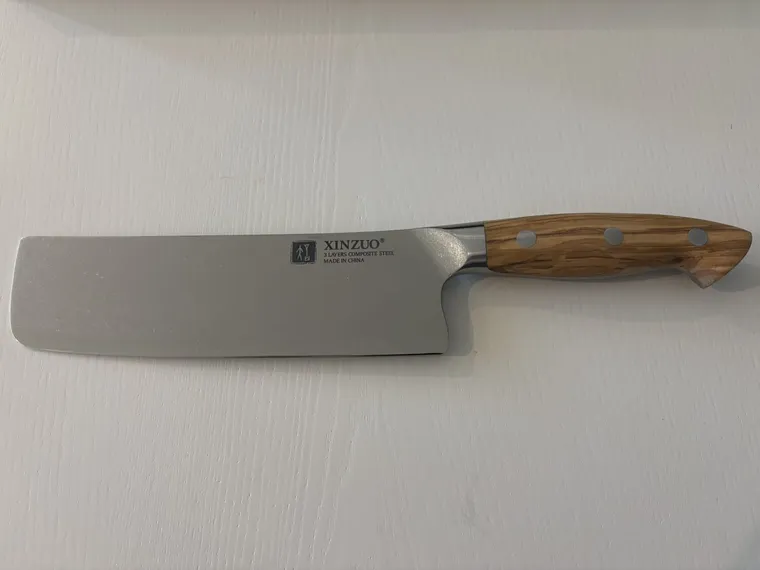
Precision is where it falls down. My usual way to slice a potato is to hold it on both sides and cut down between my fingers, and the nakiri’s tall blade gets in the way. It’s better suited to chunky veg than fine work.
Yu Series 4-piece steak knife set ($219.95)
Each steak knife has a 5″ straight edge rather than a serrated one, a rosewood handle and a visible Damascus pattern. Straight edges cut more cleanly than serrated ones but lose their edge on ceramic plates, and these need hand washing like the rest of the range.
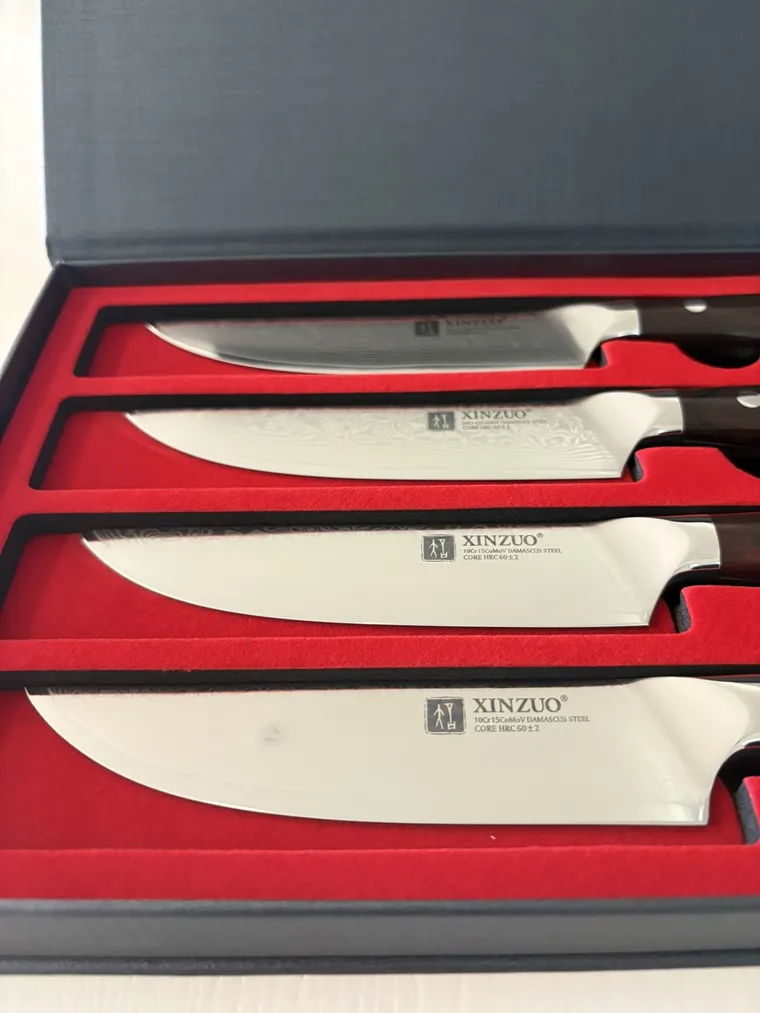
I haven’t cut a steak with them yet, so I’ll update this section after a few steak nights.
Are Xinzuo knives good value?
To see how Xinzuo’s prices stack up, I checked what the better-known brands were selling for in Australia.
| Knife | Made in | Usual price | Lowest price I found |
|---|---|---|---|
| Xinzuo Supreme 8″ | China | $65.95 | $65.95 (Xinzuo Australia) |
| Victorinox Fibrox 20cm chef’s | Switzerland | $129 | $66.49 (Amazon AU) |
| Tojiro DP 21cm gyuto | Japan | $138.95 | $138.95 (Knives and Stones) |
| Xinzuo Mo 8.5″ | China | $145.95 | $145.95 (Xinzuo Australia) |
| Global G-2 20cm | Japan | $199 | $99.95 (Kitchen Warehouse) |
| Shun Classic 20cm | Japan | $349.95 | $179.95 (Kitchen Warehouse) |
| Wüsthof Classic 20cm | Germany | $369 | $189.95 (Kitchen Warehouse) |
Prices checked on 25 October 2026. Sale prices change often.
The Supreme is easy to justify. It costs about the same as a discounted Victorinox Fibrox, the plain plastic-handled workhorse, but you get a wooden handle and a gift box for your money.
On price alone, the Mo is a harder sell. For the same $140-odd you could buy a Tojiro DP, a Japanese-made knife that enthusiasts often recommend over Chinese brands, and Kitchen Warehouse had the Global G-2 for $99.95 when I checked. However, I think the Mo earns its price on how it cuts and how it looks, and it impressed me on both.
I’d also take the star ratings on Xinzuo’s product pages with a grain of salt. They appear to pool reviews from across a whole series, so a 4.8 on one knife may include reviews of a different knife entirely.
Looking after Xinzuo knives
These aren’t knives you can throw in the dishwasher with the dinner plates, so here’s how to keep them sharp:
- Washing: hand wash and dry them straight after use. The dishwasher voids the warranty.
- Boards: use a wooden or soft plastic board, and keep them away from bones and frozen food.
- Sharpening: hone them every few uses and sharpen on a whetstone at about 15 degrees, the angle they leave the factory with.
- Handles: wipe the olive wood handle on the nakiri with food-safe mineral oil now and then.
Should you buy a Xinzuo knife?
If a friend asked which Xinzuo knife to buy for their meal kit cooking, I’d point them to the Mo, as long as they’re happy to look after it (i.e hand wash it after every meal) and keep their knuckles clear of that heel. Skip it if you have large hands.
The Supreme suits someone replacing a blunt supermarket knife on a budget. It’s comfortable and does the job, but you’ll work a little harder for each cut.
Only add the nakiri if you already own a good chef’s knife and cook a lot of vegetables. On its own it’s too limited for a meal kit kitchen.
Xinzuo isn’t for you if everything goes in the dishwasher, I treat mine with the respect they deserve to keep them sharp and enjoyable to use.
If you’ve cooked with Xinzuo knives yourself, I’d love to hear how yours have held up. Let me know in the comments below.


No comments yet